Translation Services in Delhi: Bridging Language Gaps for Businesses and Individuals
As businesses expand into international markets and individuals increasingly require multilingual documentation, Certified translation services are becoming an important part of cross-language communication. From corporate agreements and technical documents to academic certificates and immigration paperwork, accurate translation helps people and organisations exchange information clearly across linguistic and cultural boundaries.
Delhi’s position as a major commercial, administrative and educational centre creates diverse language requirements. Companies working with international clients, exporters communicating with overseas partners, legal professionals handling foreign-language records and individuals preparing documents for international use may all require specialised translation support.
Professional Translation Services in Delhi address these needs by converting written content from one language to another while preserving its original meaning, terminology, tone and context. Unlike basic word-for-word conversion, professional translation considers the purpose of the document, its intended audience and the specific language conventions involved.
Growing demand for professional document translation
Document translation is required across several sectors, including legal, medical, academic, financial, manufacturing and information technology. Businesses may need translated contracts, product manuals, employee documents, company profiles, training materials and commercial correspondence. Educational institutions and students may require translations of transcripts, degree certificates and other academic records.
Individuals applying for overseas education, employment, immigration or other official procedures may also need personal documents translated into a specified language. Depending on the receiving authority, these documents may require certified translation or additional authentication. Understanding the receiving organisation’s requirements before beginning the process can help avoid unnecessary delays.
Legal and technical documents require particular attention because inaccurate terminology may affect how information is interpreted. Medical records and pharmaceutical materials also demand careful handling of specialised terminology, figures and instructions.
Supporting businesses in multilingual markets
International business relationships often involve communication between people who do not share the same first language. Translation enables organisations to present information consistently, explain products and services to overseas customers, and communicate requirements to suppliers and partners.
For companies operating across different markets, localisation may be necessary alongside translation. Localisation adapts content to the language, cultural expectations, formats and preferences of a specific audience. This can be particularly relevant for websites, marketing materials, software interfaces, product information and customer communications.
The combination of accurate translation and appropriate localisation can help businesses make their communications more accessible while reducing the risk of misunderstandings across markets.
Importance of language expertise and quality checks
Reliable translation involves more than linguistic fluency. Translators must understand subject-specific terminology, maintain consistency and recognise situations in which a literal translation may change the intended meaning.
A structured quality process can include terminology checks, proofreading, formatting review and comparison with the original document. For sensitive assignments, confidentiality and controlled document handling are also important considerations.
The choice of language professional should reflect the document’s purpose. Legal, medical and technical content may require translators with relevant subject knowledge, while marketing and creative materials may need additional cultural adaptation.
Technology, including machine translation and artificial intelligence, can support certain stages of the translation process. However, human review remains important when accuracy, context, specialised terminology or official acceptance is critical. The appropriate workflow depends on the document, its intended use and the level of quality assurance required.
Beyond written translation
Multilingual communication needs extend beyond documents. Organisations may require interpretation for business meetings, conferences, interviews, training sessions and international delegations. Transcription services can convert recorded speech into written text, while subtitling and voice-over services help make audio and video content accessible to audiences speaking different languages.
These related services can support businesses, institutions and individuals managing communication across multiple formats. Selecting services according to the intended audience and project requirements helps maintain consistency throughout the communication process.
Meeting diverse language requirements in Delhi
As communication increasingly crosses national and linguistic boundaries, access to dependable language services remains relevant for both organisations and individuals. Clear project requirements, suitable subject expertise, confidentiality measures and a defined review process can contribute to better translation outcomes.
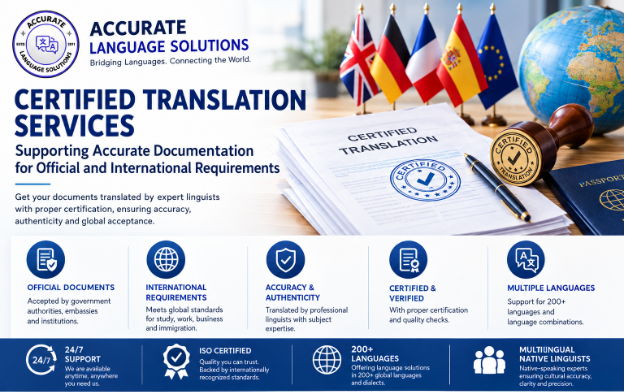
Accurate Language Solutions provides language-related services, including translation, interpretation, transcription, voice-over and other multilingual communication support. More information about its services is available at https://accuratelangsols.com/.
Certified translation services are ultimately about preserving meaning while making information understandable to a new audience. By addressing linguistic differences with appropriate expertise and quality checks, businesses and individuals can communicate more effectively across languages and borders.

